Expression Interrupted

Journalists and academics bear the brunt of the massive crackdown on freedom of expression in Turkey. Scores of them are currently subject to criminal investigations or behind bars. This website is dedicated to tracking the legal process against them.

ANALYSIS | Ethical threshold in news about children: Public interest or public curiosity?

ANALYSIS | Ethical threshold in news about children: Public interest or public curiosity?

Children are often portrayed in the media as either victims or perpetrators. According to experts, ethical journalism requires examining the underlying causes of an incident without stigmatizing the child

HİKMET ADAL

Narin Güran, the 8-year-old girl murdered in Diyarbakır in 2024; the school attacks in Maraş and Urfa; and other cases… While the incidents differ, the debate remains the same: the representation of children in the media.

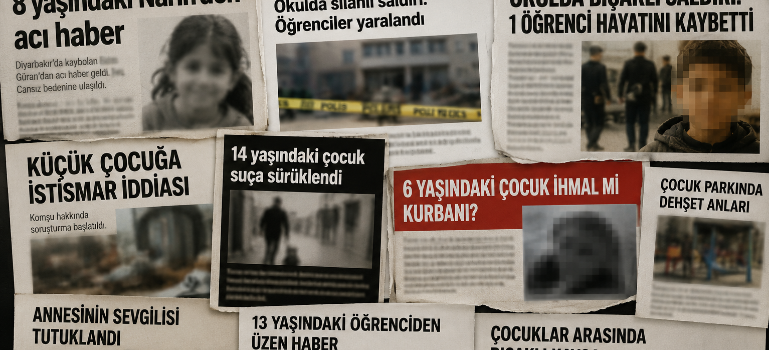
News stories featuring children are often framed in the Turkish media through the lens of the courts, public safety, and tabloid sensationalism. A child is either turned into an “innocent victim”—an object of suffering—or labeled a “perpetrator” and thrust into the public eye.

This is precisely where the ethical debate in child-related news begins: Does the child’s name, photo, school, neighborhood, family, social media account, or the details of the incident hold news value, or does it lead to the child being recognized, stigmatized, and re-traumatized today and in the future?

According to civil society activists, academics, and journalists working in the field of children’s rights, the ethical principle in news involving children is very clear: The child’s best interest must take precedence over public curiosity.

Furkan Tunçdemir: Exposing a child is not journalism

Furkan Tunçdemir of the Media and Children Association states that the media often views children not as rights-holding individuals but as part of a sensational story. According to Tunçdemir, there is a problematic narrative in news stories featuring children:

“The child is often framed either as the ‘object of victimization’ or the ‘perpetrator of danger.’ In other words, the child is not portrayed as a rights-holding individual but as a tool for eliciting pity, fear, anger, or sensationalism.

One of the most common violations we see is the disclosure of the child’s identity. The use of their photograph, the disclosure of their first and last name, details about their school, neighborhood, family, social media account, or other identifying information is very common. In some news stories, the name is supposedly censored, but the photograph, address, family information, or the location of the incident is revealed so clearly that the child is still easily recognizable.

Another common violation is the sensationalization of the incident the child experienced. Serious issues such as violence, abuse, neglect, death, or being drawn into crime are reported using terms like “savagery,” “horror,” or “chilling incident.” This language not only re-victimizes the child but also detaches the issue from its structural context.”

Tunçdemir notes that the violation becomes even more severe in news stories where children are framed as “perpetrators.” While emphasizing that children are individuals amid their developmental process who require protection, he highlights how news language often presents them to the public as “criminals,” “monsters,” or “dangerous.”

Tunçdemir stresses that in news about children, it is the “best interests of the child” that must be prioritized, not “the public interest”:

“The best interests of the child must be at the center of every news story involving a child. When producing a news story, the first question should be: ‘Will this story harm the child?’ If the child will suffer harm today or in the future when their identity is revealed, their photo is shared, their social media account is exposed, or they become identifiable through their family, this publication cannot be justified by the public interest.

In news stories where children are portrayed as perpetrators, the public interest does not lie in exposing the child. The public interest lies in discussing the negligence behind the incident, why protective mechanisms failed, where the social services system broke down, and the responsibilities of the school, family, local government, justice system, and the state.

Showing a child’s photo, revealing their name, sharing their social media account, or leaving them with a digital trail that will be tracked for life is not journalism; it is exposure.”

According to Tunçdemir, the problem with child-related news is not merely the result of individual journalists’ ethical lapses; the way newsrooms operate, the pressure to be fast, the click-based economy, and the lack of editorial oversight perpetuate this language.

“Reporting on a child is not the same as writing about an ordinary criminal case,” says Tunçdemir, noting that a journalist must ask not only “what happened?” but also “what will happen to the child if I report this story this way?” He adds:

“In news stories involving children, the question should not be ‘what happened?’ but ‘how did this incident become possible?’ If a child is subjected to abuse, neglect, violence, forced labor, being drawn into crime, or any violation of rights, we cannot speak of merely an individual incident here. There is inevitably a structural foundation.

The questions a journalist should ask are as follows: Was the family left alone during this process? Did social service mechanisms intervene earlier? Did the school recognize that the child was at risk? Did the guidance system function properly? Did the local government have protective services for children? Was there effective coordination established among law enforcement, the prosecutor’s office, the court, the child monitoring center, and social service units? Was the child’s experience of poverty, migration, violence, discrimination, or exclusion made visible within the report?”

Suncem Koçer: Hiding the identity is not enough; details can also expose the child

Suncem Koçer, an academic at Koç University, also states that the fundamental issue in news reports about children isn’t merely whether to “expose or not.”

According to Koçer, even if a news story does not reveal the child’s name or blurs their photo, it may still fail to protect the child. This is because protection is not limited to merely concealing identity information; it also depends on how the story narrates the event, which details it circulates, and whether it takes into account how the child might be affected in the future.

Koçer emphasizes that the “do no harm” principle in child-related news must be considered not just for the present but also with an eye toward the child’s life years down the line:

“We see that journalism in the media is largely driven by a motivation and reflex toward sensationalism. However, on the other hand, viewing the issue of sensationalism and protection as a binary opposition does not seem quite right to me. Because news reports can be produced that do not expose the child and keep their personal information private. But this does not necessarily mean the child is protected.

The reporter did not reveal the child’s name, did not expose them, and censored their photo, but on the other hand, they described the incident in full detail. In other words, they recounted what happened to the child not out of a protective reflex, but more as a decorative element.

Therefore, even though they did not expose personal information, they failed to protect the child by detailing the incident.

We live in the internet age. Journalists lack a perspective on whether a news story about the child will appear in search results 20 years from now based on any keyword entered into a search engine.

The principle of ‘do no harm’ comes first in ethical journalism. This applies to news stories involving children as well. For this reason, when writing a story, a journalist should not focus solely on the present moment. They must approach the story with a vision and perspective that encompasses the next 20 years.”

According to Koçer, the media’s reliance on emotion, shock, and detail rather than context in child-related news has both structural and ideological causes. Establishing context takes time, slows down the audience, and makes the rapid circulation of the news more difficult. In contrast, phrases like “chilling details,” “horror,” and “savagery” emotionally capture the reader.

Noting that this language is also evident in the Narin Güran reports, Koçer says that children are often turned into “the backdrop of a drama”:

“Context is not an easy thing. Especially for our media, which is riddled with structural issues. Context is the most important element. It is the most important element of any regime of truth or news and information practice. But due to both structural and ideological reasons, news is presented with headlines like ‘shock’ or ‘chilling details’ instead of context.

As we saw in the Narin Güran case, the child usually becomes the backdrop of a drama. The reader, in turn, clicks on these context-free, emotion-triggering news stories and stays on the page longer. This is the culture and system of journalism in Turkey now. Breaking this cycle is by no means easy.”

Koçer reminds us that childhood is also a multifaceted ideological representation. According to her, news about children does not merely tell children’s stories; it also carries adults’ anxieties regarding the family, the state, security, a sense of societal collapse, and modernity.

For this reason, the first requirement of good child-focused journalism is to make the structural conditions behind the event visible:

“If you ask what kind of context good child-focused journalism should establish, we need to discuss several layers. First, what are the structural and systemic conditions that make the mentioned event possible? This needs to be addressed very thoroughly.

For example, if a news story is being done on child labor, the legal regulations, oversight mechanisms, and—if these are not working—the reasons why they are not working, along with the political framework, must be established within the context.

When seeking expert opinions, we usually turn to psychologists or pediatricians. But a more socially diverse pool of experts—such as those specializing in social policy or children’s rights law—could help establish the context more effectively if they were included in various ways in news reports.

There is also, of course, the issue of follow-up. The tendency to focus on a single incident... It should not end once the story is published. The journalist should ask, ‘What happened to this child?’ after some time has passed.”

Nalin Öztekin: The focus of the news should be on the child’s rights, not the police report

Nalin Öztekin, bianet’s children’s news editor, says the difference between child-centered journalism and traditional police/courtroom reporting begins with the perspective from which the news is viewed. Noting that traditional court reporting often frames the incident through legal jargon, crime categories, the perpetrator-victim dichotomy, and a security perspective, Öztekin explains that when children are involved, this language can very quickly turn into a rights violation.

According to Öztekin, child-centered journalism requires a journalistic approach that does not settle for simply asking “what happened?”:

“When children are involved, this language can very quickly turn into a rights violation. Because the child is either fixed solely as a ‘victim’ or, instead of being described as a ‘child drawn into crime,’ is effectively cast as the perpetrator.

The first difference in child-centered journalism lies in the perspective. I do not limit the incident to the question ‘What happened?’; instead, I ask, ‘Which of the child’s rights were violated in this incident, which institution was responsible, which mechanism failed, and will the news cause further harm to the child?’ In other words, I place the child’s rights, safety, development, and status as a subject at the center of the news, not the police report.

This does not mean softening the news or omitting the truth. On the contrary, it means framing the truth from a more accurate perspective. Because in cases involving children, the incident is rarely isolated; it is often the result of a broader structure—such as poverty, impunity, disengagement from education, a failing care system, discrimination, migration, child labor, and lack of access to justice.”

Öztekin specifically emphasizes that the “best interests of the child” principle in child-related news does not merely mean withholding the child’s name. Because even without a name, details such as the school, neighborhood, family information, photographs, specifics of the incident, or dramatic narration can make the child identifiable:

“For me, the best interests of the child mean truly asking the question, ‘Whose interests does this story serve?’ before publishing it. The story may serve the public interest; but this public interest cannot be established by compromising the child’s privacy, safety, dignity, or future life.

Protecting the child’s best interest is not merely about withholding their name. Even without naming the child, information about the neighborhood, school, family, photographs, details of the incident, or the use of dramatic language can make the child identifiable. Sometimes, detailing the violence the child has experienced creates a re-traumatizing effect rather than generating news value.

This principle must also be considered alongside the child’s right to participation. The Convention on the Rights of the Child states that the child’s best interest is a fundamental criterion in all proceedings concerning children; the same convention also recognizes children’s right to express their views on matters that concern them. In other words, ‘the child’s best interests’ is not a paternalistic domain where adults make unilateral decisions on the child’s behalf; it is an ethical framework where the child is heard safely and their voice is taken seriously.”

Öztekin explains that when rewriting an agency news story from a children’s rights perspective, she first removes elements that expose, stigmatize, criminalize, or sensationalize the child.

She notes that phrases like “the little child,” “experienced the horror,” “horrific incident,” “crime machine,” and “stone-throwing child” sensationalize the story but render the child’s rights invisible.

According to him, what needs to be added to the story is context:

“What is this child’s relationship with school? Has the social services system been activated? Have protective and preventive systems been in place? What is the responsibility of the family, school, law enforcement, the judiciary, local government, the ministry, or relevant institutions? What do experts, children’s rights organizations, lawyers, and field workers say? News agencies often just report the incident; child rights journalism, however, seeks to make the system behind the incident visible.”

According to Öztekin, in cases of violence involving children, solution-oriented journalism means not merely seeking out good examples, but constructing the news by acknowledging that violence is systemic, not isolated. For this reason, the news should not be confined to who the perpetrator is or how the incident unfolded.

“In such stories, I pursue these questions: Which institutions has this child interacted with before? At what stage should the school, social services, healthcare system, law enforcement, the judiciary, and local government have intervened? Could the risk have been foreseen? Were the reporting mechanisms accessible? If the child filed a complaint, was it heard? If not, why could not they? Where does the responsibility of the family, the neighborhood, the school, the state, and the media begin?

Solution-oriented journalism also means not leaving the reader feeling helpless at the end of the story. It is necessary to highlight reporting mechanisms, legal avenues, expert recommendations, gaps in the child protection system, and, if possible, best practices. But in doing so, we must proceed without sensationalizing the details of the violence, while protecting the child’s identity and dignity.”

The common ground shared by all three professionals is that the fundamental responsibility of journalism in child-related news is to make the child visible without causing harm. This goes beyond merely withholding names, photos, or school information; it requires a journalistic approach that avoids confining the child to the “victim” or “perpetrator” label, investigates the structural causes behind the incident, and distinguishes between public curiosity and the public interest.

For this reason, in the Narin Güran case, the school attacks in Maraş and Urfa, or any incident of violence involving children, the news story’s question should not be limited to “what happened?” Child-centered journalism must also ask the following questions: Where did the system meant to protect the child fall short? Which institution failed to fulfill its responsibilities? How will the news story impact the child’s current and future life?

Because in child-related news, ethics do not begin after the story is published. They must be embedded from the very start—in the headline, the visuals, the opening sentence, and the unasked questions.

Top